Motivated lighting
Light that the viewer can explain by a source in the scene, such as a window, lamp or fire, even when the actual engine lights are invisible helpers placed around it.
Motivated lighting is light that has a believable cause in the scene. The Level Design Book defines a motivated light as "a light source with a plausible fixture", where a fixture is "a visible plausible source of light, like a light bulb or a fireplace" (The Level Design Book: Lighting). In film, StudioBinder describes it as "the technique used to imitate or accentuate existing light sources" (StudioBinder: What is Motivated Lighting in Film?).
The aim is readability rather than realism for its own sake. Light that has a visible cause looks plausible and can be read by the player. Light with no cause looks wrong, even if the viewer cannot say why.
#Fixtures and invisible lights
An engine light has no body. The Level Design Book calls it "actually an invisible source of light with no apparent cause", which "often looks kind of weird, and simply doesn't happen in real-life" (The Level Design Book: Lighting). So you pair invisible lights with visible fixtures: usually "an architectural feature or a decorative lamp prop", and "a window with sunlight is also like a fixture" (The Level Design Book: Lighting).
One fixture can justify many lights. A single fixture may "motivate multiple invisible in-engine light sources"; in The Level Design Book's medieval study example, "what looks like two lights is actually 11+ light sources!" (The Level Design Book: Lighting). The fixtures carry the explanation; the extra lights do the work of shaping, filling and separating.
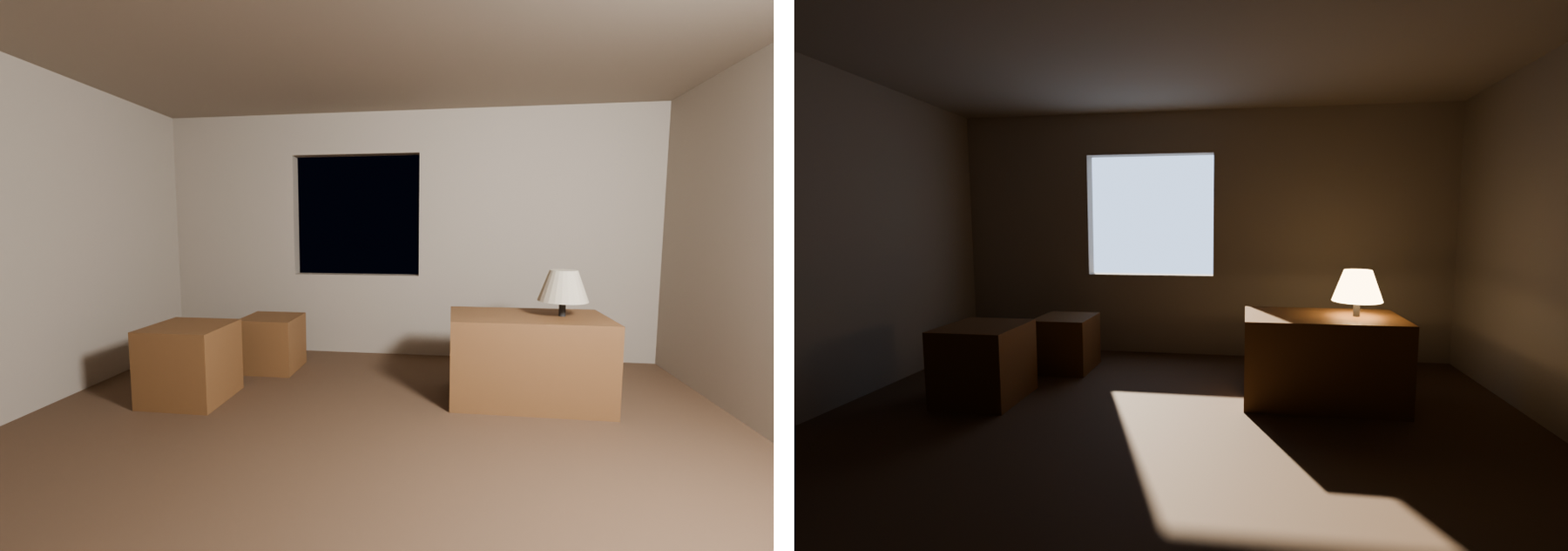

#Where it comes from
Film lighting is built around it. StudioBinder's examples: in Captain Fantastic, light "is motivated by the windows to the right of the frame"; in Get Out, it "seems to come from the practicals of the two lamps on both sides"; for 1917, Deakins built a rig "to emulate the motivated light of a burning church" (StudioBinder: What is Motivated Lighting in Film?). Practicals, lights visible in the frame, "will be able to justify to the audience where light is coming from" (StudioBinder: What is Motivated Lighting in Film?).
#Motivated lighting in games
Games need it more than film, because the player can look anywhere. Three-point roles change as the camera moves (see three-point lighting), but a visible lamp explains its light from every angle.
#How to do it
- Place fixtures first. Lamps, windows, screens, fires, emissive signs. See emissive materials.
- Match colour. StudioBinder advises: "it's important to match the color temperatures of the lights" when augmenting practicals (StudioBinder: What is Motivated Lighting in Film?). A warm lamp needs a warm light.
- Add helpers near their causes. Fill and bounce lights should sit where the fixture's light would plausibly reach.
- Hide the cheats. Betancourt notes bounce "may require black bounce cards (blockers) or bounce reduction to make it appear natural" (80 Level: Learning Lighting for Video Games).
#Related pages
three-point lighting · light and shadow · real-time lighting · emissive materials · wayfinding · environmental storytelling · baked vs. dynamic lighting · exercise: lighting one scene four ways
#Further reading and watching
References
- · Lighting · The Level Design Book · web · accessed 2026-10-21
- · What is Motivated Lighting in Film? · StudioBinder · article · accessed 2026-10-21
- · Learning Lighting for Video Games · 80 Level, 2017 · article · accessed 2026-10-21
Also consulted
- · Three point lighting · The Level Design Book · web · accessed 2026-10-21
Pages that link here
- Three-point lighting Key term
- IES profiles and light functions Key term
- Pacing and intensity Topic
- Safe rooms and rest areas Key term
- Exercise: lighting one scene four ways Exercise
Last updated 2026-10-22