Primary, secondary and tertiary forms
Working from the biggest shapes to the smallest: primary forms define the mass and silhouette, secondary forms break it into planes and features, tertiary forms add surface detail. Where the terms come from, how different artists use them, and how much tertiary detail belongs in the sculpt versus the texture.
Form hierarchy is the habit of working from the biggest shapes to the smallest. Primary forms are the large masses that give an object its silhouette. Secondary forms break those masses into planes, features and large breaks. Tertiary forms are surface detail: small cracks, pits, pores, grain. Each level sits inside the one before it, so a weak primary form cannot be rescued with tertiary detail.
The terms come from sculpture and are most often used in digital sculpting, but the idea applies to every kind of 3D work: hard-surface models, modular kits, tileable materials and whole environments.

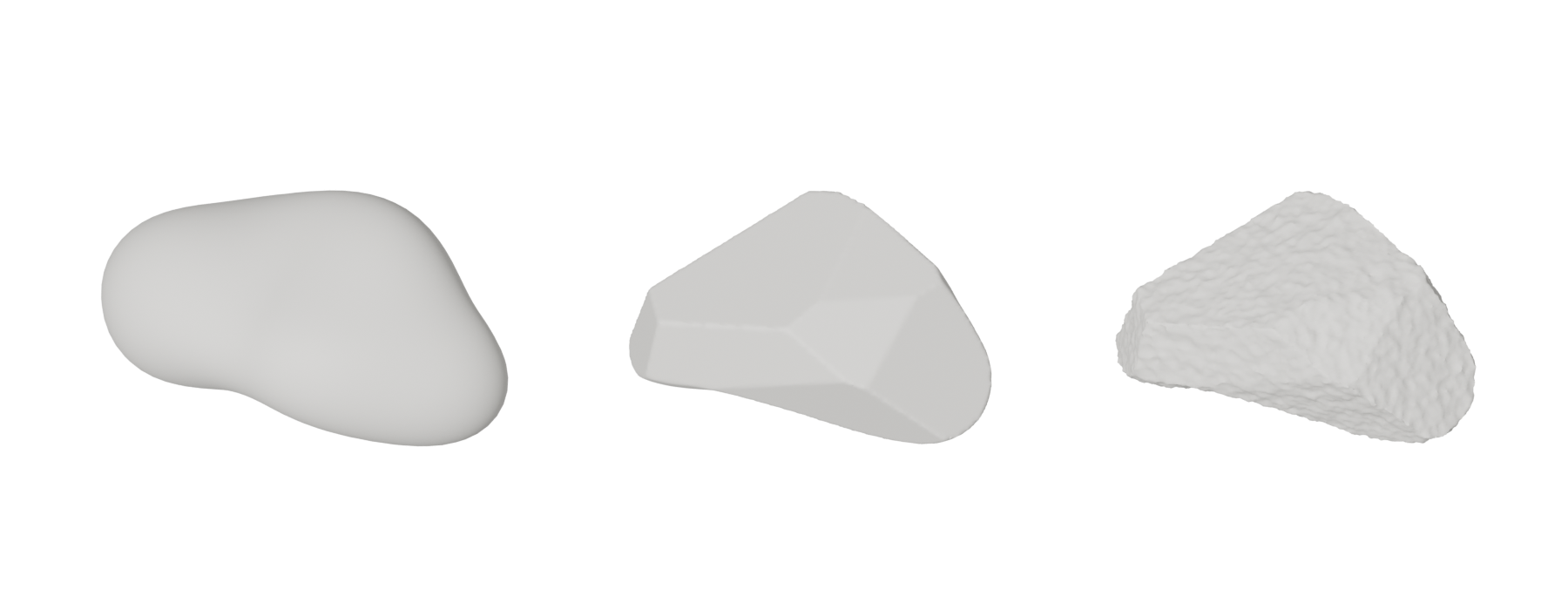
#The three levels
There is no official definition. On Polycount, Alex_J warns: "i wouldn't get too hung up on definitions because its not standardized so everybody has their own ideas what things mean" (Polycount: [Sculpting Issue] Primary, Secondary and…). The working definitions below follow the most common use.
#Primary forms
The big masses and the overall silhouette. For a head sculpt, Alex_J says primary means "the major planes are such that we have a believable figure" (Polycount: [Sculpting Issue] Primary, Secondary and…). For a rock, it is the overall mass, its proportions and how it sits on the ground. For a building, it is the block of the walls and roof.
Primary forms are what the player reads from far away and in silhouette.
#Secondary forms
The features and planes inside the primary mass. Alex_J calls secondary "any important details needed to make it look good but don't define the silhouette pretty much" (Polycount: [Sculpting Issue] Primary, Secondary and…). Another user, carvuliero, gives a compact example: "teeth cylinder is your primary form lips will be secondary and wrinkles on the lips will be tertiary" (Polycount: [Sculpting Issue] Primary, Secondary and…).
On a rock, secondary forms are the flat fracture planes, big breaks and large cracks. On a wall, they are the individual stones or bricks. In the same thread, Brandon.LaFrance points to a FlippedNormals video for the explanation (Polycount: [Sculpting Issue] Primary, Secondary and…); its title, What Most ZBrush Sculptors Get Wrong - Mid Frequency, singles out this middle band (YouTube: What Most ZBrush Sculptors Get Wrong - Mid…).
#Tertiary forms
Surface detail: "just surface level stuff. FInishing touches", in Alex_J's words (Polycount: [Sculpting Issue] Primary, Secondary and…). Small cracks, chips, pores, pitting, wood grain, fabric weave. Tertiary forms only read at close range, and they are the level most often moved out of geometry and into normal maps, detail maps and macro variation or tileable textures.
#The same order in real workflows
Artists describe the same large-to-small order even when they use different words for it.
| Artist and project | Pass 1 (primary) | Pass 2 (secondary) | Pass 3 (tertiary) |
|---|---|---|---|
| JaviSkau (31st Union), rock workflow | Blockout and silhouette, DynaMesh and ClayTubes | Medium planes and breakage, TrimSmoothBorder | Micro-detail and polish, Polish and hPolish (ArtStation) |
| Sergii Zlobin (FRAGLAB), stone wall tileable | Four block meshes; silhouettes with TrimSmoothBorder, Clay BuildUp, Planar, Trim | Cracks and damage with crack and damage alphas | Fine pore brush and a morph target (80 Level) |
| Jared Sobotta (Naughty Dog), The Last of Us Part I river rocks | Largest rocks sculpted, then laid out | Smaller rocks scattered from atlases, largest to smallest | Material detail in Substance Designer (ArtStation) |
| 3DCoat documentation | Voxel mode "for initial blocking, sketching, and silhouette building" | — | Surface mode for "pores, wrinkles, surface scratches" (3DCoat Documentation) |
The vocabulary varies. JaviSkau calls part of his second pass "primary breakage" even though it happens at the medium scale (ArtStation: Rock Sculpting Workflow in ZBrush | 3-Step…). This matches Alex_J's point: artists use different terms, but the order stays the same.
Tools are built around this order too. Blender's Multiresolution has a "Sculpt Base Mesh" option to deform the unsubdivided mesh instead of the higher levels, for broad changes that should not create surface noise (Blender Manual: Multiresolution Modifier). In Nomad, editing a lower multiresolution level keeps the higher-level detail, which is projected back automatically (Nomad Sculpt manual: Topology). You can go back to a primary change without losing tertiary work.
#Beyond sculpting
The hierarchy applies to most kinds of 3D work, not only sculpting.
- Hard-surface modeling: big masses first, then panels and vents, then bolts and labels. See hard-surface modeling.
- Tileable materials: a height-first Substance Designer graph is built in the same order: large shapes, medium detail, small detail. See tileable materials and procedural materials.
- Environments: an environment has primary forms too. Tyler Smith's ArtStation Learning course Primary Shapes starts a stone temple texture with shape design and the functional anatomy of architecture before any surface detail (ArtStation Learning: Primary Shapes). A blockout is a level's primary form; set dressing and art passes adds the secondary and tertiary layers.
- Detail maps: surfaces can be thought of as macro, mid and micro bands of detail; see detail maps and macro variation.
#How much tertiary detail belongs in the sculpt?
Sources disagree most on this point, and the answer depends on the asset, the camera and the texturing method.
#Balance and rest areas
Detailed areas need calm areas around them. A surface covered evenly in tertiary detail reads as noise, and the primary form disappears under it. Zlobin describes balancing his cracks and damage against the surrounding areas (80 Level: Creating a Stone Wall Material in ZBrush…). A practical habit is to keep large calm areas between busy ones, and to concentrate secondary breaks where the object would really break: corners, edges and places that take impacts. See sculpting damage and wear.
#Further reading and watching
References
- · [Sculpting Issue] Primary, Secondary and Tertiary Shapes ??? · Polycount, 2023 · forum · accessed 2026-10-21
- · What Most ZBrush Sculptors Get Wrong - Mid Frequency · YouTube · video · accessed 2026-10-21
- · Rock Sculpting Workflow in ZBrush | 3-Step Guide & Essential Brushes · ArtStation, 2026 · web · accessed 2026-10-21
- · Creating a Stone Wall Material in ZBrush, Substance 3D Designer & Marmoset Toolbag · 80 Level · article · accessed 2026-10-21
- · River Rock Breakdown · ArtStation, 2023 · web · accessed 2026-10-21
- · Sculpt · 3DCoat Documentation · docs · accessed 2026-10-21
- · Multiresolution Modifier · Blender Manual · docs · accessed 2026-10-21
- · Topology · Nomad Sculpt manual · docs · accessed 2026-10-21
- · Primary Shapes · ArtStation Learning · course · accessed 2026-10-21
- · Rock Breakdown · ArtStation, 2023 · web · accessed 2026-10-21
- · Erosion Breakdown · ArtStation, 2023 · web · accessed 2026-10-21
- · Low Poly Models (PS1 Era) - Guides, Advice, etc.? · Polycount, 2013 · forum · accessed 2026-10-21
- · How to Make Atmospheric Stylized Modular Ruins with ZBrush & Substance 3D · 80 Level · article · accessed 2026-10-21
Pages that link here
- Sculpting software Reference
- Visual hierarchy and readability Topic
- Shape language Topic
- Silhouette Key term
- Scale and proportion Topic
- Hard-surface modeling Topic
- Greebles Key term
- Kitbashing Topic
- Digital sculpting Topic
- Multiresolution and subdivision levels Key term
- Base meshes for sculpting Key term
- Alphas and stamps Key term
- Macro normals Key term
- Sculpting rocks and cliffs Guide
- Sculpting damage and wear Guide
- Tileable sculpts Guide
- Tileable materials Topic
- Detail maps and macro variation Topic
- Exercise: your first game-ready prop Exercise
- A 12-month learning roadmap Guide
Last updated 2026-10-22