Leading lines
Edges, alignments and directions in a scene that carry the eye towards a subject. In games they often carry the player's feet as well.
Leading lines are edges, alignments or implied directions in a scene that carry the eye towards something. Roads, rails, rooflines, cables, rows of lamps, a character's gaze: anything the eye can follow can lead it. In a game, the player often follows with their feet too, which makes leading lines a wayfinding tool as well as a composition tool.
#Practical and virtual lines
Mateusz Piaskiewicz separates two kinds (Game Developer: Composition in Level Design):
- Practical lines: "Visible lines drawn by edges and composition elements." He cites chimneys and building edges in Half-Life 2 that lead the eye up a skyscraper.
- Virtual lines: "Not obviously drawn on the composition but made by composition elements that draw directions." In Half-Life 2: Episode Two, Alyx's line of sight points the player at an event on the horizon.
Virtual lines include gaze, pointing, a row of footprints, or the direction a vehicle faces. They are easy to forget.
#Leading lines in games
The Level Design Book does not use the term "leading lines", but its wayfinding page lists "ground composition" examples that work the same way: "planks that extend off the ledge (Uncharted), train tracks (Team Fortress 2)", and a door frame in Half-Life 2 "pointed the door frame outwards into the city square" (The Level Design Book: Wayfinding). Its list also includes "lines of collectible items or powerups (Donkey Kong Country)" and a "trail of blood on floor (Doom)" (The Level Design Book: Wayfinding). Those are leading lines made of objects, the basis of breadcrumbing.
Corridors are the clearest case. In one-point perspective, every floor seam, ceiling light strip and wall pipe converges on the same vanishing point. Put the exit there and light it, and the whole room points at it.

Light can draw lines too. The Level Design Book's D6 "path / boundary" pattern angles spotlights to wash a wall evenly, and its "focal frame" uses two matching lights such as torches or sconces to mark a passage (The Level Design Book: D6 lighting). A row of lamps is a dotted line the eye joins up.
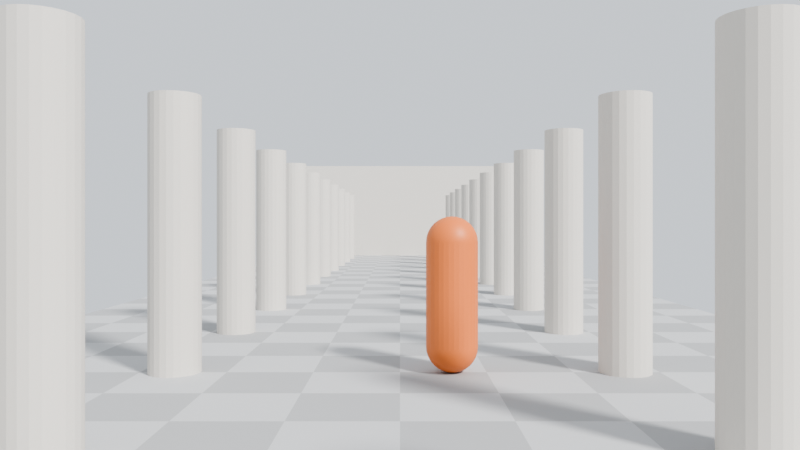
#Direction and mood
Piaskiewicz attributes moods to directions: horizontal lines "bring out breadth and depth", vertical lines "highlight the height and strength of the composition", curved S-shaped lines run smoothly through a scene, and angled lines "give the impression of dynamic and active scene" (Game Developer: Composition in Level Design).
#Moving cameras and fixed shots
In a fixed shot you can place lines exactly. Jared Sobotta's portfolio advice pairs a focal point with "a 'foreground, mid ground and background' to lead the eye" (CGSociety: How to Create a Stunning Portfolio with Jared…). In gameplay the camera moves, so lines that only converge from one spot are fragile; lines on the ground, such as paths, rails and curbs, tend to stay in view as the player walks along them. Rockstar's Miriam Bellard explores this problem, applying film ideas such as shots, editing and 2D screen design to spaces the player controls (gdconf.com: Learn to do game environment design the…; YouTube: Environment Design as Spatial Cinematography…). See cameras, lenses and field of view.
#Related terms
composition · focal point · visual hierarchy and readability · wayfinding · breadcrumbing · sightlines and vistas · critical path · light and shadow · cameras, lenses and field of view
#Further reading and watching
References
- · Composition in Level Design · Game Developer, 2014 · article · accessed 2026-10-21
- · Wayfinding · The Level Design Book · web · accessed 2026-10-21
- · D6 lighting · The Level Design Book · web · accessed 2026-10-21
- · Winter Street Scene: Environment Production Breakdown in UE4 · 80 Level · article · accessed 2026-10-21
- · How to Create a Stunning Portfolio with Jared Sobotta · CGSociety · article · accessed 2026-10-21
- · Learn to do game environment design the Rockstar way at GDC 2019 · gdconf.com, 2019 · web · accessed 2026-10-21
- · Environment Design as Spatial Cinematography: Theory and Practice · YouTube (GDC), 2019 · talk · accessed 2026-10-21
Also consulted
- · Indiana Jones and The Great Circle: Shanghai Environment Breakdowns · ArtStation, 2025 · article · accessed 2026-10-22
Pages that link here
- Composition Topic
- Focal point Key term
- Visual hierarchy and readability Topic
- Light and shadow Topic
- Cameras, lenses and field of view Topic
- Sightlines and vistas Key term
- Wayfinding Topic
Last updated 2026-10-22